

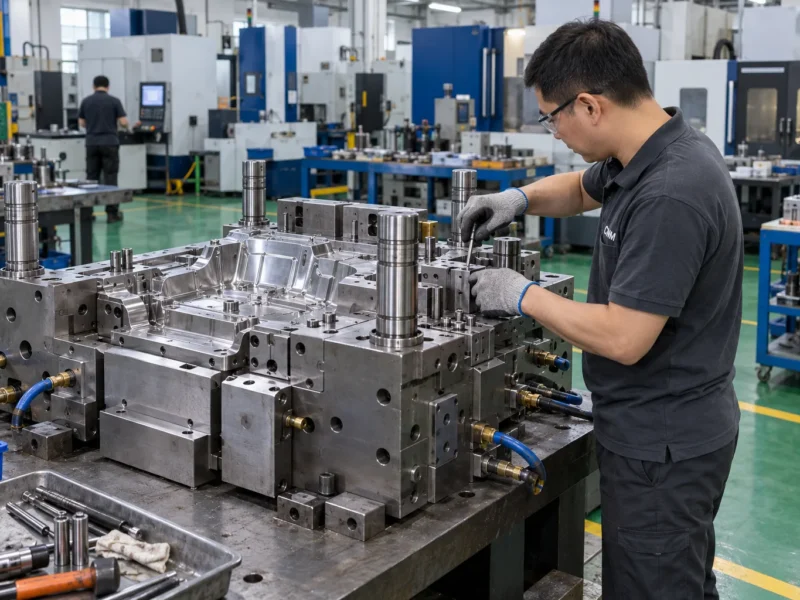
Two die casting dies for parts of similar size can differ several times in price. The cost is in the steel, the machining and EDM hours, and the mechanisms built into the die. Knowing the drivers helps you design a part that is cheaper to tool and compare quotations on the same basis.
Main cost drivers
| Driver | Why it matters |
|---|---|
| Part size and projected area | Sets insert and mold base size, and the machine size needed. |
| Number of cavities | More cavities lower the part price but raise the die price. |
| Slides and core pulls | Each undercut needs a slide with its own machining, cooling and maintenance. |
| Insert steel and heat treatment | Premium hot-work steels such as ESR H13 grades cost more but resist heat checking longer. |
| Cooling and thermal control | More water or thermal oil circuits mean more machining, and better quality and cycle time. |
| Gating and simulation | Simulation and refined gating cost engineering time but cut trial loops and porosity. |
| Surface and texture | Polish or texture on cosmetic faces adds hours. |
| Trim die | Usually a separate tool for removing runners, overflows and flash. |
Costs outside the die price
- Trials and sample castings
- Machining fixtures and inspection gauges
- Design changes after die design approval
- Die maintenance, stress relieving and replacement inserts over the die life
How to compare quotations
- Check that every supplier quotes the same part revision, alloy and annual volume.
- Compare the die specification: insert steel and hardness, cavities, slides, cooling, expected shot life.
- Ask what is included: DFM, simulation, trim die, trials, first article inspection.
- Ask who owns the die, who pays for insert replacement and what happens to the die if you move production.
- Look at die price and part price together over the product life.
Many savings come from the part design itself; see the die casting design guidelines.
Frequently asked questions
Why do aluminum dies wear faster than zinc dies?
Aluminum is cast roughly 250 °C hotter, so the die surface goes through stronger heating and cooling on every shot. This causes thermal fatigue, seen as heat checking, plus soldering and erosion near the gate.
Is a multi-cavity die always cheaper overall?
No. It pays off at high volumes; at lower volumes a single-cavity die with a higher part price can cost less in total.
Who maintains the die?
Normally the caster maintains the die during production. Ownership, maintenance and insert replacement terms belong in the tooling agreement.
Have a casting to quote? Tell us the part, the alloy and the annual volume through our inquiry form. We reply by e-mail, and you can send the drawing and 3D file in that thread for a DFM review and quotation.