

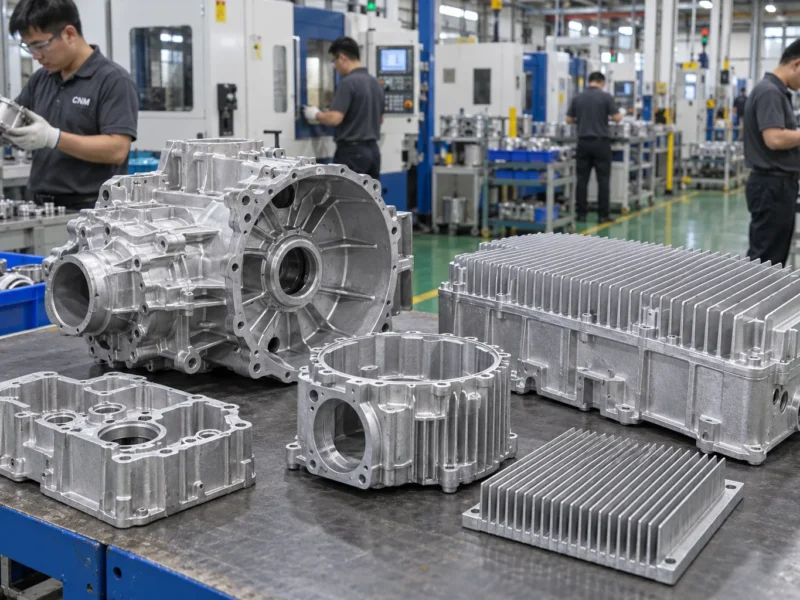
A380 and ADC12 are the standard aluminum die casting alloys. A380 is the North American designation (Aluminum Association, ASTM B85); ADC12 is the Japanese JIS designation used across Asia, and in China it is supplied as YL113. Buyers often ask whether one can replace the other. Often it can, but the chemistry is not the same.
Comparison
| A380 | ADC12 | |
|---|---|---|
| Standard | ASTM B85 / AA designation | JIS H 5302 |
| Silicon (typical range) | About 7.5–9.5% | About 9.6–12% |
| Copper (typical range) | About 3–4% | About 1.5–3.5% |
| Zinc (max) | 3.0% | 1.0% |
| Closest equivalent | EN AC-46000 (approx.) | A383 |
| Fluidity | Very good | Excellent (more silicon) |
| Hot cracking resistance | Good | Very good |
| Tensile strength (typical) | About 320 MPa | About 300 MPa |
| Elongation (typical) | About 3.5% | About 2–3% |
| Machinability | Good | Good |
| Anodizing | Poor (grey) | Poor (grey) |
Typical values from published data on separately cast test bars; check the standard for exact limits.
Which to choose
- If the drawing calls out A380, ADC12 is often accepted after agreement, but the chemistry differs. Get written approval from whoever owns the specification.
- For very thin walls and long flow paths, the higher silicon of ADC12 fills better.
- For parts that need anodizing, high ductility or good corrosion resistance, neither is ideal. Look at a low-copper alloy, a different finish or a different process.
More alloys are compared on our die casting alloys page.
Frequently asked questions
Is ADC12 the same as A383?
ADC12 is close to A383, which has more silicon than A380. They are commonly treated as equivalents, with small differences in limits.
Can I substitute ADC12 for A380?
Often, but only with the agreement of whoever owns the specification, because chemistry and properties are not identical.
Which alloy is better for heat sinks?
Both are used and conduct heat similarly. For higher thermal conductivity, alloys with less silicon and copper can be considered, at some cost in castability.
Have a casting to quote? Tell us the part, the alloy and the annual volume through our inquiry form. We reply by e-mail, and you can send the drawing and 3D file in that thread for a DFM review and quotation.